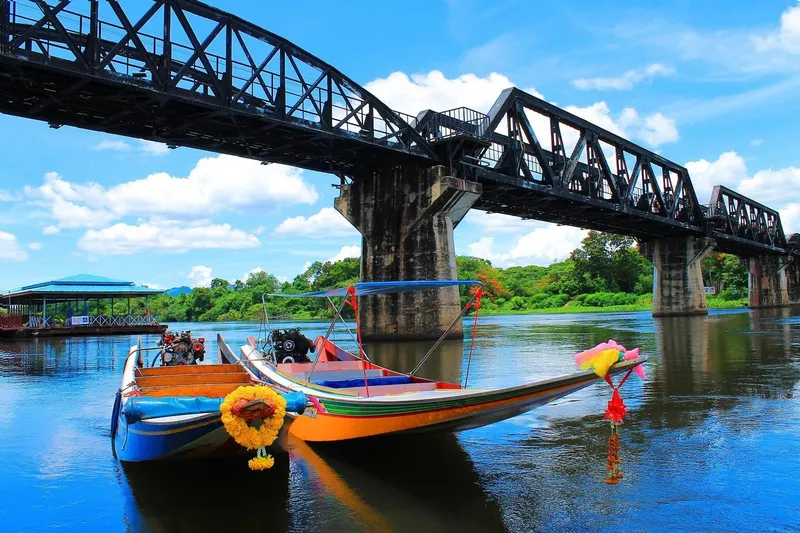
- Visit the Bridge on the River Kwai — the actual wartime structure immortalised in film
- Walk a section of the Death Railway, built by Allied POWs through limestone cliffs
- Pay respects at the Kanchanaburi Allied War Cemetery
- WWII museum visit with artefacts and personal accounts from the construction era
- Rated 4.5★ by 6,000+ guests — Bangkok's most-reviewed historical day trip
About the River Kwai Day Trip
The day tours from bangkok thailand collection includes some extraordinary options, but few carry the historical weight of a full-day River Kwai trip from Bangkok. In a single day you move between two completely different worlds: the teeming streets of Bangkok at sunrise and, by mid-morning, the jungle-framed banks of the River Kwai in Kanchanaburi province — a place where the Second World War left an indelible mark on the landscape and on human memory.
This tour combines the three centrepieces of the Kanchanaburi historical circuit: the Bridge on the River Kwai, the Kanchanaburi Allied War Cemetery, and the JEATH War Museum. Together they tell the story of the Thai-Burma Death Railway — 415 kilometres of track pushed through dense jungle and over the River Kwai by more than 60,000 Allied prisoners of war and an estimated 200,000 Asian labourers. Around 100,000 people died during its construction between 1942 and 1943.
This is not a light sightseeing trip. It is a genuine act of remembrance and historical education, wrapped in one of the most memorable full-day journeys you can take out of Bangkok.
What the River Kwai Day Trip Covers
The day trip is structured around three major historical sites, all within a short distance of each other in Kanchanaburi, roughly 130 kilometres northwest of Bangkok. Each site offers a different perspective on the same chapter of history — architectural, ceremonial and documentary.
The Bridge on the River Kwai
The original steel bridge spans the River Kwai Yai at the northern edge of Kanchanaburi town. The curved steel sections you see today are the originals — the two square outer spans were rebuilt after Allied bombing raids in 1945. Walking across the bridge gives you an immediate sense of its scale, and standing at its centre above the slow-moving river it is possible to understand just how significant this structure was to the Japanese war supply chain running into Burma.
A historic steam locomotive is permanently stationed nearby, providing context for the railway operation that the bridge served.
The Death Railway Walk
South of Kanchanaburi, the Hellfire Pass section of the Death Railway represents the most brutal engineering challenge of the entire line. Cutting through solid limestone cliff, this stretch was hacked out by hand over 12 weeks of continuous day and night shifts — the blazing torchlight that gave the section its name is still a haunting image. The tour includes a walk along a preserved section of the original track, with interpretive signage that places each step into the context of the labour that went into it.
Kanchanaburi Allied War Cemetery
The cemetery is administered by the Commonwealth War Graves Commission and contains the graves of 6,982 Allied prisoners of war — primarily British, Dutch and Australian — who died during the construction of the Death Railway. The grounds are immaculate and the silence here is profound. Rows of identical white stone markers extend across a green lawn shaded by frangipani trees.
Many stones carry personal inscriptions chosen by families. Visitors are asked to dress respectfully and to maintain a quiet, reverent demeanour throughout.
JEATH War Museum
JEATH stands for Japan, England, Australia/America, Thailand and Holland — the nationalities most directly involved in the Death Railway. The museum is housed in a reconstruction of the bamboo huts that served as POW barracks, and its exhibits include original photographs, personal testimonies, tools used during construction, and maps showing the full extent of the railway. The personal dimension of the museum — letters, diaries, hand-drawn portraits — makes it the most emotionally immediate of the three sites.
The History of the Death Railway
Understanding the three sites you visit is far more meaningful with some historical context. The Death Railway, formally known as the Burma-Thailand Railway, was constructed between June 1942 and October 1943 under orders from Imperial Japan to create a supply route into Burma following Allied naval blockades in the Bay of Bengal.
Bridge Over the River Kwai
The bridge you visit today became globally known through Pierre Boulle's 1952 novel and the Academy Award-winning 1957 film, though the film takes considerable dramatic licence with history. The real bridge was built by prisoners of war and local labourers working under extreme conditions — dysentery, cholera and malaria were constant threats, and the punishment for insufficient progress was severe. The bridge was bombed by Allied aircraft three times between 1944 and 1945, destroying the outer two spans.
The Japanese forced POWs to repair it after each raid. After Japan's surrender, the bridge and a portion of the railway near the Thai border were retained as a functioning rail line. Trains still cross the bridge today — a local service from Bangkok to Nam Tok — and the slow passage of a train across the original steel spans remains one of the more surreal moments available to a visitor in Southeast Asia.
Kanchanaburi War Cemetery
The cemetery was established after the war by the Commonwealth War Graves Commission, which exhumed and relocated the remains of prisoners who had been buried in makeshift graves along the railway route. Of the 6,982 graves, the majority are British (3,568), followed by Dutch (1,896) and Australian (1,371), with smaller numbers from other Allied nations. The average age on the grave markers is sobering — many of the men who died here were in their twenties.
The cemetery is open to the public daily and entry is free. It is maintained to the same standard as CWGC cemeteries worldwide, which is to say flawlessly.
JEATH War Museum
Established in 1977 by the abbot of Wat Chai Chumphon temple, the JEATH Museum was the first memorial museum dedicated to the Death Railway in Thailand. Its location beside the river — close to where the original POW camp stood — is deliberate. The bamboo recreation of the original barracks is basic and intentionally so; the objective is to convey conditions rather than dramatise them.
In recent years a second, larger JEATH museum has opened nearby with expanded exhibits and more modern display methods, and both are worth visiting if time allows. The tour typically includes one of the two.
Your 12-Hour Day: River Kwai Day Trip Itinerary
The tour runs for approximately 12 hours and is well-paced for a long day out. Departure from Bangkok is early — this is deliberate, to arrive at the sites before the midday heat and to allow time at each location without rushing.
-
07:00
Departure from Bangkok
Air-conditioned coach departs from a central Bangkok pickup point. The drive to Kanchanaburi takes approximately 2 hours along the Bangkok–Kanchanaburi highway. Your guide provides historical background during the journey, so that by the time you arrive you already have a clear picture of what you are about to see.
-
09:00
Bridge on the River Kwai
First stop is the bridge itself. You have time to walk across the bridge, visit the nearby steam locomotive, and explore the small market area adjacent to the bridge without feeling rushed. Your guide explains the engineering process and the wartime significance of the structure. Photographs are easy here — the bridge is photogenic from multiple angles, particularly from the riverbank below.
-
10:30
Death Railway Walk — Hellfire Pass
The coach continues to the Hellfire Pass section of the Death Railway, where you walk along a preserved stretch of the original track through the limestone cutting. The Hellfire Pass Memorial Museum at the start of the walk provides essential context before you set out. The walk itself takes 30–45 minutes at a comfortable pace.
-
12:30
Lunch
Lunch is taken at a riverside restaurant in Kanchanaburi town. The setting — tables overlooking the River Kwai — is a quiet moment in the day. Thai dishes are typically on offer alongside some Western options. Lunch costs are not usually included in the tour price; your guide will confirm this on the day.
-
14:00
Kanchanaburi Allied War Cemetery
The afternoon begins at the war cemetery. Your guide walks with the group and is available to answer questions, but most visitors prefer to spend part of this time in their own quiet reflection. There is no right way to visit a place like this. Allow at least 30–40 minutes to walk the full extent of the cemetery and read the grave inscriptions.
-
15:00
JEATH War Museum
The final historical site of the day is the JEATH War Museum. The bamboo barracks reconstruction, the original photographs and the personal accounts from survivors take 45–60 minutes to absorb properly. This is the most intimate of the three sites and tends to be the one that stays with visitors longest.
-
16:00
River Kwai Boat Ride
Before the return journey, the group takes a short boat ride on the River Kwai itself. Seen from the water, the bridge is even more impressive — a steel lattice rising out of jungle-lined banks. The boat ride lasts around 30 minutes and provides a final, peaceful perspective on the river that connects all the history of the day.
-
16:30
Return Journey to Bangkok
The coach departs Kanchanaburi for the 2-hour return drive to Bangkok. Most guests use the journey back to decompress, review photographs, and talk through the day with fellow travellers. Your guide is on hand for any final questions about what you have seen.
-
~19:00
Arrival back in Bangkok
Drop-off at the original departure point in central Bangkok. The exact time depends on traffic conditions — Bangkok's evening rush can extend the return journey by 30–45 minutes, particularly on weekdays.
Important Things to Know
What to Bring
- Sunscreen and a hat — the bridge, the Hellfire Pass walk and the cemetery all involve extended time outdoors in direct sun
- Comfortable, closed-toe walking shoes — the Hellfire Pass section includes uneven terrain and steps
- A refillable water bottle — staying hydrated across a 12-hour day is essential
- Camera or charged phone for photography — the bridge, the railway cutting and the river scenery are all highly photogenic
- Respectful attire for the war cemetery — no shorts, sleeveless tops or singlets at the cemetery; long trousers or a lightweight wrap work well
- Cash in Thai Baht for museum entrance fees, lunch and any purchases at the market near the bridge
What Is Not Allowed
- Disrespectful behaviour at the war memorial and cemetery — this is a place of active remembrance and is treated accordingly by guides and local staff
- Swimming in the River Kwai without authorisation — the river current can be deceptively strong
- Drone photography without a valid Thai Civil Aviation Authority permit — enforcement is taken seriously at historical sites in the Kanchanaburi area
- Climbing or sitting on the bridge structure itself — the walkway across the bridge is open but the steel framework is not for climbing
Conduct at the War Cemetery
The Kanchanaburi Allied War Cemetery is a working place of mourning — families still visit these graves, and CWGC staff maintain it with that in mind. Keep voices low, walk on the paths rather than across the grass, and treat the grave markers with care. Photography is permitted but should be done with discretion.
Your guide will brief the group before entering.
Who This Tour Is For
The River Kwai day trip from Bangkok is best suited to travellers with a genuine interest in Second World War history, or those who want to experience one of Asia's most significant memorial sites. It also works well for general travellers looking for a meaningful day out of Bangkok that goes beyond temples and shopping.
The pace is measured rather than rushed. Your guide allows time at each site and the itinerary is not crammed. That said, it is a full 12 hours from door to door, and the emotional weight of the historical content means that some people find it a heavier day than expected.
Not suitable for
- Travellers who are uncomfortable with long bus journeys — the return drive from Bangkok to Kanchanaburi is approximately 2 hours each way
- Those who find wartime history content emotionally distressing — the cemetery and museum contain graphic historical photographs and detailed accounts of suffering
- Very young children — the historical cemetery and museum content is not designed for young children, and the day is too long for most kids under 8
River Kwai Day Trip from Bangkok — Frequently Asked Questions
How long is the drive from Bangkok to the River Kwai?
The drive from central Bangkok to Kanchanaburi takes approximately 2 hours each way in normal traffic conditions. The tour departs early (around 07:00) specifically to avoid the worst of Bangkok's morning congestion and to arrive at the bridge before the heat of the day. The return journey can take slightly longer if Bangkok's evening traffic is heavy.
Is the Bridge on the River Kwai the original wartime bridge?
Yes and no. The curved steel spans you see in the centre of the bridge are the originals, dating from 1943. The two outer square spans were destroyed by Allied bombing raids in 1944–45 and rebuilt after the war. The wooden trestle piers that supported the original temporary bridge no longer exist. Your guide will walk you through the bridge's full history on arrival.
Do I need to dress a particular way for the war cemetery?
Yes. The Kanchanaburi Allied War Cemetery is a place of active remembrance maintained by the Commonwealth War Graves Commission. Out of respect for the fallen and for families who visit, shorts and sleeveless tops are strongly discouraged. Long trousers and a sleeved shirt are appropriate. If you are wearing shorts, bring a lightweight sarong or wrap to wear inside the cemetery — it is warm and the walk is easy, so this is not an inconvenience.
Is lunch included in the tour price?
Lunch is not typically included in the standard $55 tour price. The group stops at a riverside restaurant in Kanchanaburi where you order and pay for your own meal. Expect to spend around 150–250 Thai Baht (approximately $4–7) for a Thai main dish. Museum entrance fees are also usually additional — budget around 100–150 THB per site. Your tour guide will confirm all costs before each stop.
Can I book the River Kwai day trip for a group?
Yes. The tour runs in a shared group format, which is how most travellers experience it, but private group bookings are available for families or larger parties who prefer a dedicated guide and vehicle. For private options and pricing, see the full range of bangkok thailand tours on our homepage.
What Travellers Say About the River Kwai Day Trip
One of the most moving days of our whole trip to Southeast Asia. The guide was incredibly knowledgeable — he had answers to every question we asked at the cemetery and at the museum. The boat ride at the end was a lovely way to close out such a full day. Highly recommended for anyone with even a passing interest in WWII history.
We were a little apprehensive about the long drive but it really was fine — the guide kept us engaged the whole way with stories and background. The cemetery was deeply emotional. The bridge itself was impressive but it was the personal stories at the JEATH Museum that stayed with me. A very well-organised and respectful tour.
I had seen the film years ago but visiting the actual site is something else entirely. The scale of what was built here and the human cost behind it is only really understandable when you are standing at the bridge or walking between the graves. Our guide handled the content with real care and dignity. Worth every bit of the $55.